
Services

Core Competencies:

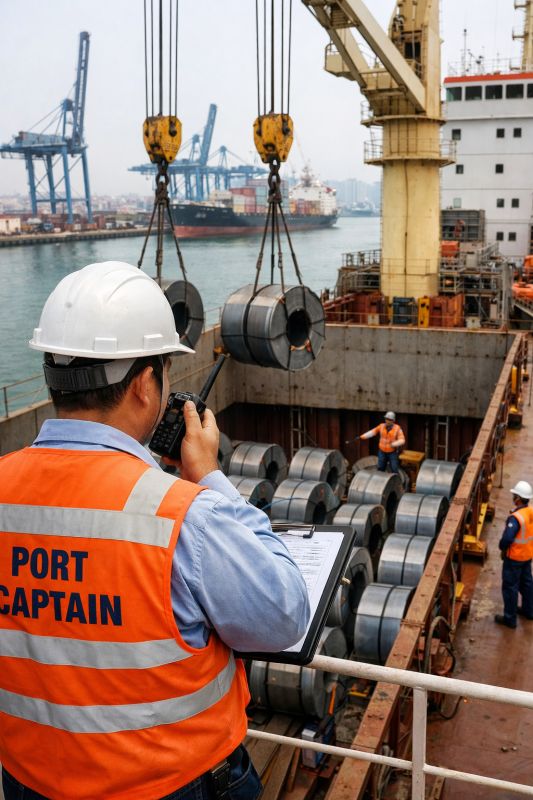
Port Captaincy

We would like to offer the services of Port Captaincy for your vessels calling various ports. Apart from active participation in planning and executing the cargo operations in a speedy and efficient manner we can also contribute in the planning stage for maximising the intake.

Continuous supervision

We supervise all the necessary stuffs during discharge or loading of all types of cargoes and assist Master.

• Observing damage or deterioration to cargo and checking liabilities.
• Supervising measurement and methods of packing.
• Supervising stowing and  dunnaging.
• Managing stevedores
• Looking after safety of the ship and selecting  stable and seaworthy ship.
• Supervising shifting, tainting, sweating,  broaching of cargo.
• continuous checking of draught marks, heel-list and load lines.

Hold Inspection Prior Breaking Bulk

We offer ship holds inspection service to ensure the condition of vessel and ship are suitable for loading of cargo, IMO regulation before stowage handling. Our surveyors are also available to conduct the suitability of container condition and other transport means before shipping of goods or breaking the bulk. It is our duty to identify ship’s cargo holds are in cleanliness, drying, free-smell.

Draft Survey

A draft survey is a means of determining the weight of any materials being loaded into (or discharged from) a vessel. Our experienced and highly qualified professionals can conduct a draft survey on your behalf and produce an independent draft survey report.

On/Off Hire Condition and Bunker Survey of the Vessel.

It’s a visual inspection of vessel holds, main deck and cargo working areas are performed to identify any damage present prior to the vessel going on/off hire. This survey is carried out by us and after the completion we issue an attestation certificate. … On/Off hire vessel rob bunker survey.

P & I Insurance Survey

The following provides the scope of P & I survey services:

  • Pre-Entry and Routine Condition Surveys
  • Loss Prevention Surveys
  • Collision, Pollution and Other Casualties and Accidents
  • Ultrasonic Leak Testing of Hatch Covers
  • Draft and Ullage Surveys
  • Entire Scope of Cargo Surveys
  • Personnel Injury and Death

Loss Minimization Survey

Distribution system provides a link between the high voltage transmission system and low voltage consumers thus I2R loss in a distributed system is high because of low voltage and high current. Distribution companies (DISCOs) have an economic enticement to reduce losses in their networks. Usually, this enticement is the cost difference between real and standard losses. Therefore, if real losses are higher than the standard ones, the DISCOs are economically penalized or if the opposite happens, they obtain a profit. Thus loss minimization problem is a well researched topic and all previous approaches vary from each other by selection of tool for loss minimization and thereafter either in their problem formulation or problem solution methods employed. Many methods of loss reduction exist like feeder reconfiguration, capacitor placement, high voltage distribution system, conductor grading, Distributed Generator (DG) Allocation etc. This paper gives a bibliographical survey, general background and comparative analysis of three most commonly used techniques (i) Capacitor Placement, (ii) Feeder Reconfiguration, (iii) and DG Allocation for loss minimization in distribution network based on over 147 published articles, so that new researchers can easily find literature particularly in this area.

    Port worthiness for scrap vessels

    The scrapping of ocean-going vessels is currently done mainly in a few states in Asia.
    Because of the hazardous materials contained in the ships, the scrapping poses a significant
    danger to both the workers in the shipbreaking yards as well as to the environment. The
    international community has been aware of the problems related with shipbreaking for over a
    decade, and has in different ways tried to improve the practices. Moreover, attention has
    turned to the regime governing the movement of waste, as it has been argued that a vessel
    destined for scrapping should be defined as waste under the regime. The waste movement
    regime contains provisions that control and restrict the transboundary movement of waste.
    Applying the regime could thus hinder vessels containing hazardous materials from being
    scrapped in Asia.

    Valuation of the vessels, crafts, barges, launch etc.

    CW Kellock & Co Ltd are internationally recognised ship valuers, whose clients include banks, lawyers, insurers, national shipping lines, the Government of India and other government agencies.


    Pre Purchase Inspection for Prospective Buyer

    The inspected areas include structural integrity, safety features, electrical and electronic systems, powertrain, suspension, fuel system, emissions, steering, comfort system (heat/air), security system, exhaust, interior, wheels and rims, and apparent state of general maintenance. Hidden damage from crashes, flood, or rough use are checked. Important for newer vehicles is an inspection of the onboard computer system, including recently cleared computer codes. The inspector also investigates for vehicle identification alteration, lack of recent license plates, salvage title, and odometer fraud. Commercial vehicle inspections also evaluate the condition of items relevant to commercial use, such as conspicuity materials, markings and placards, insurance, service limits, coupling devices, etc.

    Tanker Surveys – Ullaging, Sampling and Continuous Monitoring

    The Floating turret system enables the vessel to be easily moored at the bow and oil transferred conventionally to the midship manifold.

    Floating production, storage, and offloading systems (FPSO) can offer significant advantages over fixed production platforms, particularly in remote offshore locations where deep water, strong ocean currents, and harsh weather conditions may occur, or where export pipelines are difficult to install or uneconomic to run.

    Liquid cargo is nowadays usually transferred using an articulated arm loading/discharge system, and groups of arms are often found onshore refineries or offshore loading facilities. It connects to the tanker’s manifold usually located near the center of the ship.

    Loading oil cargo in a tanker ship requires utmost diligence in planning, and most careful consideration will need to be made for safe operation. Following are the necessary procedures at various stages of loading oil cargo

    Hull & Machinery Survey of vessel for damage and Loss Assessments

    Nobel Marine offers a complete range of Marine Surveys to clients such as Ship Owners, Charterers and others who have asset interests in the marine related sector. Such surveys are conducted with the best combination of proven technical resources and expertise in a comprehensive manner to certify the quality and quantity of cargo and assess the condition of vessels.

    Log Measurement and tally survey

    Lorem ipsum dolor sit amet, consectetur adipiscing elit. Ut elit tellus, luctus nec ullamcorper mattis, pulvinar dapibus leo.

    Container:

    Stuffing, De-Stuffing Surveys

    A short description of this quality. Make these lines enticing enough to prove that you are the best in all you do.

    Condition, Damage, Repair Estimate

    A short description of this quality. Make these lines enticing enough to prove that you are the best in all you do.

    Off/On Hire Survey

    On-Hire Surveys / Off-Hire Surveys of vessels or marine structures undertaken either before the vessel or structure is delivered into a charter, or redelivered from a charter. The survey report should include a detailed description of a vessel’s cargo spaces/deck areas structural condition, cargo space cleanliness, bunkers on board, listing of the vessel’s statutory certificates, portable securing equipment, etc.

    We Provide The Best Service In Industry

    Add A Line That Tells Users How Easily They Can Get In Touch With You